
Camping Cabin Fire Pit: Check Rules Before You Light
On this page
Quick answer
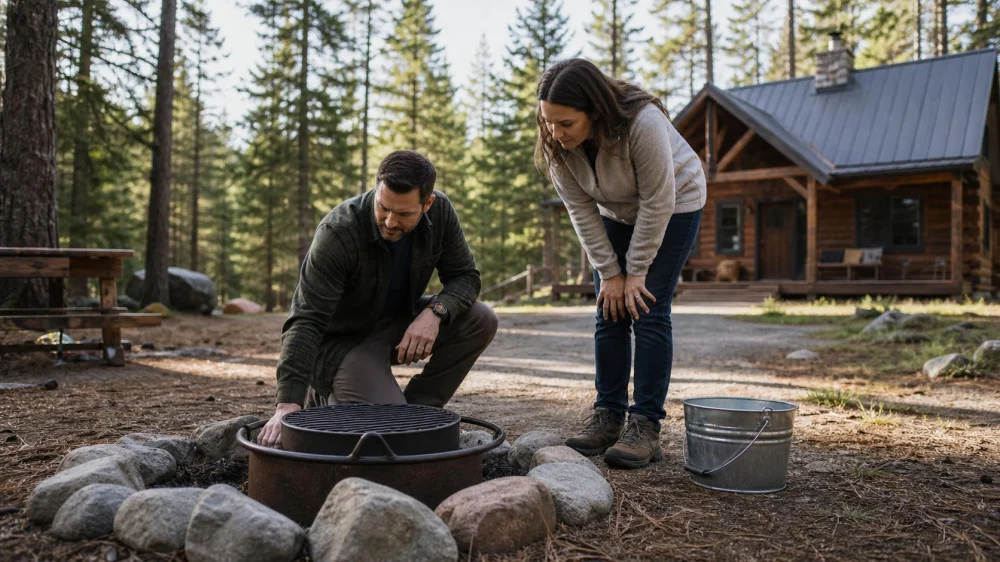
Before using a camping cabin fire pit, confirm that fires are currently allowed by the property and land authority. Use only the designated ring and permitted local fuel, clear nearby combustibles as directed, keep water and a tool ready, supervise continuously, and keep the fire small. Extinguish with water, stir, wet again, and verify every ember is cold before leaving or sleeping. If restrictions or conditions are unclear, do not light it.

Confirm permission
A campfire permission check verifies the current property rules, public restrictions, weather conditions, approved location, fuel, and extinguishing method before ignition. A fire ring does not prove fires are allowed today.
Check official fire restrictions, red-flag warnings, drought or air-quality rules, property messages, and local land-manager notices. Ask whether charcoal, propane appliances, wood fires, or all flames are treated differently. Recheck on the day of use because conditions change.
Inspect the site
Use only the designated ring or appliance. Look above and around for branches, dry grass, roots, leaf litter, wooden structures, tents, vehicles, fuel, and wind-driven sparks. Follow the property's required clearance. Do not move the ring or build a new pit.
Have enough water available before lighting, plus a shovel or tool if permitted. Keep children and pets outside a controlled boundary. Avoid loose clothing and never leave one person responsible while distracted by cooking or alcohol.
Use allowed fuel
Use approved firewood or fuel. Do not transport firewood across restricted areas; invasive pests can move with it. Never burn rubbish, plastics, treated or painted wood, batteries, pressurised containers, glass, food waste, or unknown material.
Do not use petrol, alcohol, aerosol, or another accelerant to start or revive a fire. Follow manufacturer instructions for approved fire starters and fuel appliances. Never use outdoor combustion equipment inside the cabin, tent, vehicle, porch, or another enclosed area because of fire and carbon monoxide hazards.
Control and extinguish
Keep flames and fuel within the ring and at the size allowed. Stop adding fuel early enough to finish before quiet hours, departure, wind changes, or sleep.
- Pour water over all embers, not only visible flames.
- Stir ash and coals with a suitable tool.
- Add more water and stir again.
- Check for heat carefully without touching coals.
- Continue until the entire bed is cold.
Do not bury a fire or assume sand alone extinguishes it. If a fire escapes, alert others, call emergency services, and follow property evacuation instructions; do not risk injury fighting a spreading wildfire.
Fire-pit checklist
- Current permission and weather checked.
- Designated ring and clearance verified.
- Allowed local fuel only.
- Water and tool ready.
- Continuous sober supervision assigned.
- Small controlled fire maintained.
- Cold-out procedure completed.
Limitations and notes
This guide cannot determine whether conditions are safe at a specific cabin. Follow current property, fire authority, land-manager, weather-service, and appliance instructions. When instructions conflict, use the more restrictive rule.
FAQ
Does an existing ring mean fires are allowed?
No. Restrictions can close it temporarily.
Can I burn fallen branches?
Only if property and land rules permit collection and burning.
Is a propane fire pit allowed during a ban?
Rules vary. Verify the exact appliance and current restriction.
Can I leave glowing coals for the morning?
No. Extinguish until cold before leaving or sleeping.
Evidence notes
This guide reflects common wildfire-prevention practice: current permission, designated sites, allowed fuel, continuous supervision, water readiness, and cold-out verification. No fire condition is guaranteed safe.
Next steps
Save the property and local fire-restriction sources, pack water capacity and a suitable tool, and set a no-fire backup activity. Make one adult responsible for final cold-out verification.
 Spacious Skies Campgrounds - Country Oaks4.0 (353 reviews)
 Greenbelt Campground4.0 (186 reviews)
 Walter's Mobile Home Village3.0 (25 reviews)
 Seabreeze Park3.0 (5 reviews)
 Hermitage Cabin (PATC): Parking Area4.0 (10 reviews)
 Mar lu Ridge0.0 (0 reviews)
 Why Winter is the Best Time for a Camping Cabin Getaway
 Best Remote Camping Cabins for Stargazing and Night Adventures in the U.S.
 The 10 Must-Have Amenities for a Comfortable Stay in Your Camping Cabin
 Winter Camping Cabins: How to Stay Cozy and Warm in the Cold
 How to Create the Ultimate Outdoor Experience with a Camping Cabin
 Best Camping Cabins with Stunning Views of National Parks and Forests