
Camping Cabin Smoke and CO Alarms: Test, Exit, and Report
On this page
Quick answer
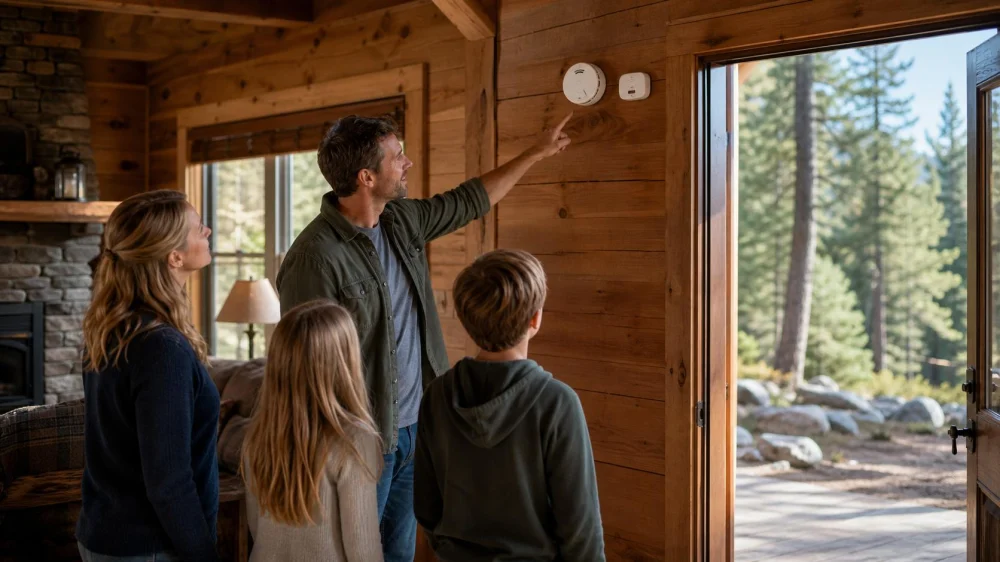
Confirm that a camping cabin has working smoke and carbon monoxide alarms before settling in, especially if it contains fuel-burning appliances, a fireplace, or an attached garage. Use only the alarm’s test button as instructed. If an alarm sounds or anyone develops possible carbon monoxide symptoms, get everyone outside to fresh air, call emergency services, and do not re-enter until responders say it is safe.
Never remove batteries, cover an alarm, or dismiss repeated chirps without reporting them. The property operator should correct missing, damaged, expired, or malfunctioning equipment.

Before arrival
Ask the host which alarms are installed, where they are located, and whether the cabin has propane, natural gas, kerosene, a wood stove, fireplace, generator connection, or attached vehicle space. Confirm the emergency address, mobile coverage, after-hours contact, and evacuation meeting point.
Guests who are deaf or hard of hearing should ask about compatible visual or vibrating alert equipment. Do not assume a remote cabin has the same alarm arrangement as a hotel.
Check alarms at check-in
- Locate smoke and carbon monoxide alarms without moving or opening them.
- Read posted instructions and identify exit doors and windows.
- Press only the labeled test button if the host permits or instructions direct it.
- Listen for a strong alarm and look for visible fault or end-of-life indicators.
- Report missing alarms, damage, weak chirps, or a failed test immediately.
- Keep bunks, luggage, decorations, and clothing away from alarms and exits.
- Show every guest the exits, outdoor meeting point, and emergency address.
A test button checks selected alarm functions; it does not prove that the air is safe or that every sensor will perform under all conditions.
If an alarm sounds
For a smoke alarm or signs of fire, leave immediately, close doors behind you if safe, meet outside, and call emergency services from a safe location. Do not search for the fire, collect belongings, or return for pets once doing so would delay escape.
For a carbon monoxide alarm, move everyone—including pets—to fresh outdoor air and call emergency services. Headache, dizziness, nausea, weakness, confusion, chest pain, or unusual sleepiness can be warning signs, but carbon monoxide itself cannot be reliably seen or smelled. Do not ventilate and re-enter as a substitute for professional clearance.
Reduce cabin risks
- Operate heating and cooking equipment exactly as the property instructs.
- Never use a grill, camp stove, charcoal, or unapproved heater indoors.
- Keep generators outdoors far from doors, windows, and vents.
- Do not idle a vehicle near the cabin or in an attached space.
- Keep combustibles away from stoves, fireplaces, and heaters.
- Use the provided fireplace screen and never leave a fire unattended.
- Report soot, unusual appliance behavior, fuel odour, or damaged vents.
What not to do
Do not silence an alarm by removing its power source. Do not paint, tape, or hang objects over it. Do not attempt electrical repairs, replace hardwired units, or diagnose combustion appliances as a guest.
If nuisance alarms recur during ordinary approved cooking, notify the operator. Relocating an alarm or disabling it can leave the cabin unprotected and may violate rules or law.
Cabin alarm checklist
- Emergency address saved offline
- Two usable exit routes identified where available
- Outdoor meeting point agreed
- Smoke and CO alarms located
- Permitted test completed and faults reported
- Fuel-burning appliances identified
- Children and guests briefed
- Phones charged and flashlights accessible
- Operator and emergency contacts available
Frequently asked questions
Can I bring my own portable CO alarm?
It may add awareness when used to its instructions, but it does not replace required installed alarms or property maintenance.
What does a periodic chirp mean?
It may signal low power, a fault, or end of life. Report it and follow the manufacturer or operator instructions.
Can I sleep after a CO alarm stops?
Stay outside and await emergency guidance. A stopped alarm does not establish that the source is safe.
Should I test an alarm with smoke?
No. Use only the built-in test method specified for the device.
What if the cabin has no alarm?
Do not accept an unsafe arrangement. Contact the operator and consider alternative lodging; use local authorities when required.
Sources and evidence notes
Fire-safety and public-health guidance consistently treats smoke alarms, carbon monoxide alarms, rapid evacuation, and outdoor generator placement as essential protections. Exact alarm placement, testing schedules, and legal requirements depend on the device, fuel equipment, property type, and jurisdiction.
Follow posted cabin rules, manufacturer instructions, local fire guidance, and directions from emergency responders.
Conclusion and next steps
Before unpacking, locate alarms and exits, complete only the permitted test, and report defects. Keep combustion outdoors or in approved appliances, protect exits, and make sure everyone knows the meeting point. When any alarm sounds, prioritize leaving and calling for help; troubleshooting can wait until professionals declare the cabin safe.


 Parkview Manufactured Housing & RV Community3.0 (111 reviews)
 Vanguard Associates3.0 (42 reviews)
 Artillery Ridge Campground Gettysburg Horse Park4.0 (1016 reviews)
 Chips Folly Family Campground4.0 (91 reviews)
 Lake Somerset Family Campground4.0 (206 reviews)
 Holloway Beach4.0 (62 reviews)
 Why Winter is the Best Time for a Camping Cabin Getaway
 Best Remote Camping Cabins for Stargazing and Night Adventures in the U.S.
 The 10 Must-Have Amenities for a Comfortable Stay in Your Camping Cabin
 Winter Camping Cabins: How to Stay Cozy and Warm in the Cold
 Best Camping Cabins with Stunning Views of National Parks and Forests
 How to Create the Ultimate Outdoor Experience with a Camping Cabin