
Camping Cabin Storm Plan: Alerts, Shelter, and Backup Routes
On this page
- Quick answer
- Ask storm questions before booking
- Check forecasts and receive alerts
- Identify the safest available shelter
- Map primary and backup routes
- Build a communication plan
- Pack a compact weather kit
- Recheck conditions on arrival
- Respond when a warning is issued
- Wait for hazards after the storm
- Frequently asked questions
- Conclusion and next steps
Quick answer
Before staying in a camping cabin, check the official forecast and alerts, ask the property where guests should shelter, and map two routes that avoid low-water crossings. Save the host and local emergency contacts, share your itinerary, and pack lights, power banks, water, medicines, and sturdy footwear. If a warning is issued, follow official instructions immediately rather than waiting to see conditions from the porch.
A cabin is not automatically a safe storm shelter. Its construction, location, elevation, nearby trees, access roads, and available shelter all matter. Local emergency authorities and property staff provide the situation-specific instructions.
Crescent Mobile Home Park LLC
Gloucester CityCamden CountyNew Jersey
1400 Crescent Blvd, Gloucester City, NJ 08030, USA
Ask storm questions before booking
- What severe weather is common during the planned season?
- Where is the designated shelter, and is it open overnight?
- How far is the shelter from the cabin and is the route step-free?
- Does the property sit in a flood-prone area or behind a low-water crossing?
- How are guests notified if mobile service is weak?
- Who decides whether the property closes or evacuates?
- What refund or rebooking terms apply to severe weather?
Request current answers. A generic listing photograph cannot show whether a route, shelter, or communication system is available now.

Silvermead
Freehold TownshipMonmouth CountyNew Jersey
100 Cardinal Way, Freehold Township, NJ 07728, USA
Check forecasts and receive alerts
Use official weather information for the cabin’s exact area, not only the city you are traveling from. Check before departure, during the drive, and after arrival. Enable emergency alerts on charged phones and consider a battery-powered weather radio where reception is uncertain.
Learn the difference between an outlook, watch, warning, and evacuation instruction used by the relevant agency. A warning or official direction calls for action; do not rely on visual observation, a single app, or social-media rumors.
Identify the safest available shelter
Ask the host for the designated location for tornadoes, severe wind, lightning, hail, and other local hazards. A small cabin, vehicle, tent, porch, pavilion, or tree-covered area may not provide suitable protection. Do not assume a basement exists or is accessible.
Walk the shelter route in daylight if conditions are safe. Note keys, codes, stairs, gates, lighting, and space for children, older adults, pets, and mobility devices. If the official shelter cannot meet the group’s needs, choose a different property or leave before conditions deteriorate.
Map primary and backup routes
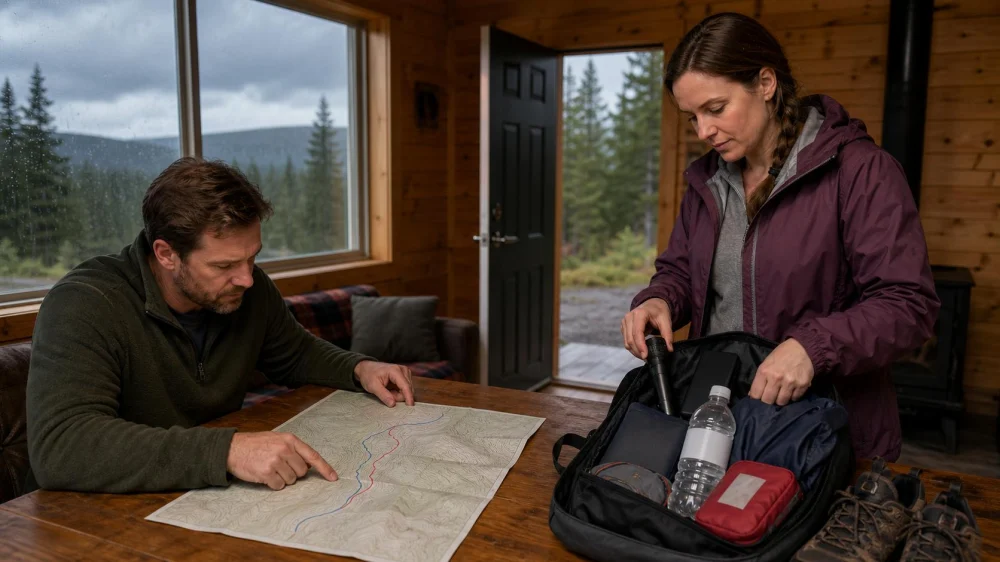
Save offline maps and mark at least two ways to reach a main road or designated shelter. Ask whether gates lock at night and whether narrow roads, bridges, steep grades, or creek crossings can become impassable.
Never drive, walk, or cycle through floodwater. Depth, current, road damage, and debris are difficult to judge. If authorities direct evacuation, leave by the recommended route early; waiting can reduce safe options.
Build a communication plan
Share the property address, cabin number, route, guest names, vehicle details, host contact, and planned return time with someone not on the trip. Agree on check-in times and what that person should do if the group cannot be reached.
Inside the group, choose a meeting point and backup point. Keep phones charged, download important details, and write critical numbers on paper. A satellite communicator may be useful in remote areas when carried and operated according to its service limitations.
Pack a compact weather kit
- flashlights or headlamps for each person and spare batteries;
- charged power banks and compatible cables;
- safe drinking water and ready-to-eat food;
- essential medicines, medical information, and first-aid supplies;
- sturdy closed-toe footwear, rain layers, and warm clothing;
- a whistle, paper map, emergency contacts, and basic hygiene items;
- pet carriers, leads, food, water, and identification when applicable.
Keep the kit together where it can be reached quickly. Do not block doors or store it in a vehicle if the vehicle may be inaccessible during a warning.
Recheck conditions on arrival
- Confirm the property address and your cabin location.
- Ask whether forecast, shelter, road, or evacuation information changed.
- Locate exits and the designated shelter before dark.
- Park as directed without blocking emergency access.
- Secure loose personal items and keep footwear, keys, and weather kit ready.
- Check that all group members understand the plan.
Report damaged windows, doors, alarms, or communication equipment. Do not make structural repairs or alter property safety devices.
Respond when a warning is issued
Follow official alerts and property emergency instructions without delay. Move to the designated shelter using the known route, take the weather kit and essential medicines, and account for everyone. Use a leash or carrier for pets.
Stay away from windows, porches, isolated trees, water, and metal fences during severe conditions. Avoid showers and corded equipment when lightning is nearby. Do not use grills, generators, camp stoves, or vehicles to produce power or heat inside or near openings.
If instructed to evacuate, do not remain to protect belongings. If travel is already unsafe, contact emergency authorities or property staff for direction rather than choosing an unverified shortcut.
Wait for hazards after the storm
Remain sheltered until officials indicate the immediate threat has passed. Additional storm cells, lightning, falling branches, flash flooding, damaged roads, and downed power lines can remain dangerous. Treat every downed line as energized and keep well away.
Use a flashlight rather than flame to inspect. Leave and report gas odor, smoke, sparking, structural movement, flooding, or damaged trees leaning over the cabin. Photograph property damage only from a safe location and follow host instructions about relocation or checkout.
Frequently asked questions
Is a car safer than a cabin during a tornado warning?
Do not make a general assumption. Use the designated substantial shelter and follow official local instructions. Planning before the warning is essential.
Can I stay under the cabin porch during lightning?
An open or partially enclosed porch is not a reliable lightning shelter. Move to the appropriate substantial building or hard-topped vehicle as directed.
What if the cabin has no mobile signal?
Ask how the property delivers alerts, consider a weather radio or suitable communicator, save information offline, and establish an outside contact before the trip.
Should I cross shallow water on the access road?
No. Do not enter floodwater. Turn around, use an approved alternate route, and contact authorities or the host for instructions.
Conclusion and next steps
Choose a cabin only after confirming its alert method, designated shelter, access risks, and severe-weather policies. Before departure, monitor official forecasts, save two routes, share the itinerary, and pack a compact kit. On arrival, walk the plan in safe conditions. When a warning or evacuation order arrives, act immediately and leave belongings behind if necessary.

 Winding Brook Mobile Homes Pk3.0 (21 reviews)
 Clifton Lisle5.0 (1 reviews)
 Riverwoods Mobile Home Community3.0 (88 reviews)
 Holly Acres Campground4.0 (132 reviews)
 Delaware Seashore State Park North Campground4.0 (168 reviews)
 Calvert Cliffs Campground4.0 (16 reviews)
 Why Winter is the Best Time for a Camping Cabin Getaway
 Best Remote Camping Cabins for Stargazing and Night Adventures in the U.S.
 The 10 Must-Have Amenities for a Comfortable Stay in Your Camping Cabin
 Winter Camping Cabins: How to Stay Cozy and Warm in the Cold
 Best Camping Cabins with Stunning Views of National Parks and Forests
 How to Create the Ultimate Outdoor Experience with a Camping Cabin