
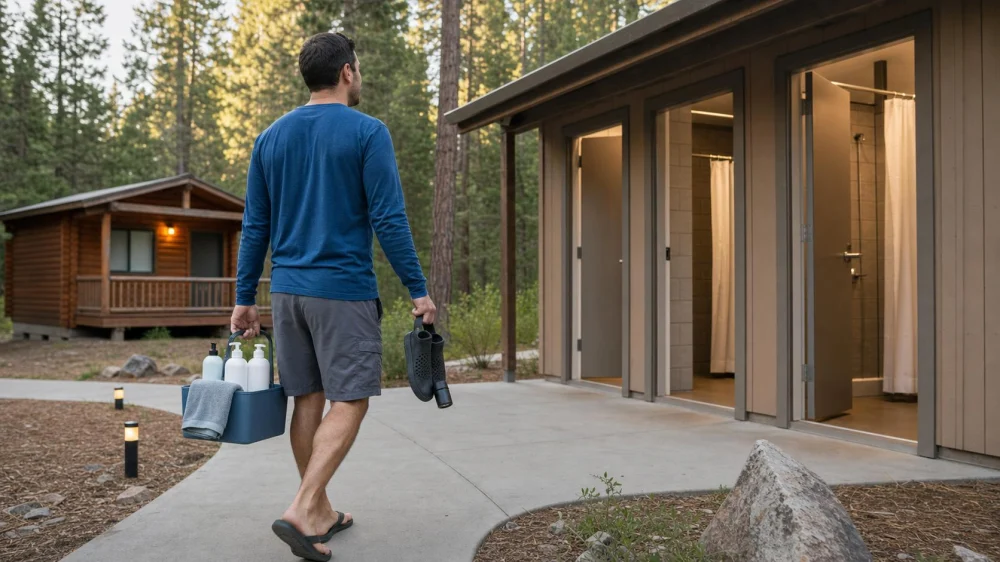
Camping Cabin Bathroom and Shower Checklist
On this page
Quick answer
Before booking a camping cabin, confirm whether the toilet and shower are private, shared, seasonal or off-site. Ask the distance, route, hours, hot-water limits, payment method, access code, accessibility, privacy and supplied items. Pack a light, nonslip footwear, quick-dry towel, toiletries, shower bag and backup hygiene plan, because “restrooms available” does not guarantee showers.
This guide is for U.S. frontcountry camping cabins and shared campground facilities. Primitive, backcountry, boat-access and winter sites may have vault toilets, no running water or no bathing facility. Use the current property and park information for the exact dates.
Delaware City Mobile Home Community
Delaware CityNew Castle CountyDelaware
115 5th St, Delaware City, DE 19706, USA
Confirm the exact facility type
Campground listings use similar words for very different setups. A “bathroom” may mean a private room inside the cabin, a nearby comfort station with flush toilets, a seasonal bathhouse, a vault toilet or a separate commercial shower facility.
Ask the property or booking service:
- Does this exact cabin have a private toilet, sink or shower?
- If facilities are shared, which building serves the cabin?
- Are toilets flush, composting, portable or vault type?
- Are showers on-site, and do they have hot water?
- Are showers individual rooms, stalls or family/unisex spaces?
- Are sinks intended for washing people, dishes, laundry or only hands?
- Is the water potable, and where is that status posted?
- Are facilities open for the full season and the exact dates?
The National Park Service advises campers to learn a campground's facilities and regulations before arrival, including whether showers, flush toilets and potable water are available. Its campground planning guidance also suggests weighing convenience against the noise and light of a nearby bathroom building.
Do not infer shower access from a shower icon without opening the detail. It may refer to another campground loop, a seasonal building, a fee-based facility miles away or an amenity limited to registered guests.
Thousand Trails Lake & Shore
DennisCape May CountyNew Jersey
515 Corsons Tavern Rd, Ocean View, NJ 08230, USA
Check hours, access and cost
A shower can be present but unavailable when you need it. Ask for current operating hours, cleaning closures, seasonal dates and the last entry time.
Clarify:
- Whether cabin guests receive shower access automatically.
- Whether a door code, wristband, key or receipt is required.
- The price per use or per timed interval.
- Accepted coins, tokens, cards, apps or exact cash.
- Where tokens or codes are obtained when the office is closed.
- Whether hot water is continuous, timed, solar-heated or limited.
- Whether queues form at common morning or evening times.
- Whether children need adult supervision.
Save the instructions offline because mobile service may be weak. If a code is private to registered guests, do not post it publicly or write it on the shower-house door.
For a late arrival, identify a toilet that remains available overnight and light the route before leaving the cabin. Do not assume office hours equal restroom hours.
Verify the complete accessible route
An accessible cabin does not automatically mean the nearest shower or toilet meets the same needs. Ask about the route from parking and cabin to the facility as well as the room itself.
Useful questions include:
- Is the path paved, compacted, gravel, grass or boardwalk?
- What is the distance, slope and cross-slope?
- Are there steps, thresholds, narrow gates or steep ramps?
- Is the route lit at night?
- Are doorways and stalls wide enough for the mobility device?
- Is there a bench, transfer space, grab bars and a handheld shower?
- Can a companion assist in a private or family room?
- Is an accessible stall kept available and functioning?
Ask for current photos or measurements when a feature is essential. “ADA site” in a reservation system may describe the cabin or parking pad rather than every nearby amenity. Confirm emergency and backup arrangements if the accessible facility is out of service.
For sensory, cognitive or medical needs, ask about lighting, fan noise, temperature, privacy, queues and storage for equipment. Do not leave medical devices unattended in a damp shared room.
What to pack for a shared shower house
Shared facilities are easier when the entire kit fits in one water-resistant bag and leaves both hands available for doors and balance.
- Quick-dry towel plus a small hand towel.
- Nonslip shower footwear.
- Travel-size toiletries in sealed containers.
- Hanging toiletry bag or caddy that does not sit on the floor.
- Clean clothes in a waterproof bag.
- Separate bag for damp clothes and towels.
- Headlamp or flashlight with spare power.
- Required tokens, coins, key or access method.
- Toilet paper and hand sanitiser as a backup, stored according to wildlife rules.
- Any personal accessibility aid that is safe for a wet area.
Confirm whether soap, shampoo and towels are supplied rather than assuming. Bring fragrance-free options when scent affects you or others, but do not use products in streams, lakes or outdoor drains unless the site explicitly permits it. “Biodegradable” does not make soap suitable for direct use in natural water.
Store toiletries, toothpaste, wipes and scented items according to food-storage and wildlife rules. A bathroom kit can attract animals even when it contains no food.
Inspect facilities after arrival
Locate the route in daylight. Confirm the building, hours, code, payment machine, emergency exit and alternate facility. Note steps, roots, loose gravel and unlit junctions before a nighttime trip.
Before using a stall, check:
- Door and privacy latch work.
- Floor is not flooded or unusually slippery.
- Bench, hooks and grab bars are secure.
- Drain is flowing and water temperature can be controlled.
- Ventilation and lighting are adequate.
- No broken glass, sharp object, exposed wire or damaged fixture is present.
Report a hazard to the host or management and use another stall. Do not attempt electrical or plumbing repairs in a shared facility.
Keep valuables with you or use the designated secure method. Do not leave a phone, wallet or cabin key visible on a shared bench. Keep the shower short when others are waiting and leave the stall ready for the next camper.
Important limits and hygiene notes
Wear footwear in shared wet areas and avoid direct contact between toiletries and the floor. Cover cuts, wash hands after toilet use and before food preparation, and do not share towels or razors.
Never mix cleaning products or spray a strong disinfectant in an occupied communal building. Staff need to select products compatible with the facility, septic system and surfaces. Report contamination rather than improvising.
If no shower is available, use a property-approved backup such as sponge bathing in the designated area. Do not bathe or wash with soap in a creek, lake or at a drinking-water spigot. Dispose of greywater only as the campground directs.
For diarrhoea, vomiting, an open infected wound or another contagious condition, avoid shared facilities when possible and seek medical guidance as appropriate. Severe injury, fainting, breathing trouble or another emergency needs emergency help, not only the campground host.
Frequently asked questions
Do all camping cabins have showers?
No. Some cabins share a shower house, some campgrounds have toilets but no showers, and others use an off-site paid facility. Verify the exact cabin and dates.
Are campground showers free?
Not always. They may be included, coin- or token-operated, timed, guest-only or run by another concession. Ask how to pay when the office is closed.
Does a restroom icon mean flush toilets?
No. It can represent a vault, composting or portable toilet. Open the amenity details and ask the operator when the distinction matters.
Should I choose a cabin next to the bathroom?
It improves convenience but may bring more foot traffic, doors, lights and noise. Compare distance and route safety with your need for a quieter site.
Can I wash dishes in a bathroom sink?
Only if the campground permits it. Many facilities prohibit dishwashing in hand sinks. Use the designated wash station and dispose of water according to site rules.
Sources and evidence notes
The facility-verification principle follows National Park Service frontcountry camping guidance, which notes that amenities vary and showers are not universal. Exact accessibility, water, fees, hours and hygiene facilities are property-specific. Confirm them with the operator.
Conclusion and next steps
Before reserving a camping cabin, identify the exact toilet and shower setup, how far it is, when it operates, what it costs and whether the complete route meets your needs. Pack a compact shower kit and offline access details. On arrival, inspect the route and stall before dark and report hazards. A listing that says “restrooms” is only the beginning of a useful facilities check.
 Vineland Hills Manufactured Home Community3.0 (55 reviews)
 Bodine Field Campground4.0 (110 reviews)
 Naugatuck Pines5.0 (2 reviews)
 Safety Park1.0 (2 reviews)
 Deluxe Cabin 3065.0 (1 reviews)
 Country Club Estates3.0 (2 reviews)
 Why Winter is the Best Time for a Camping Cabin Getaway
 Best Remote Camping Cabins for Stargazing and Night Adventures in the U.S.
 The 10 Must-Have Amenities for a Comfortable Stay in Your Camping Cabin
 Winter Camping Cabins: How to Stay Cozy and Warm in the Cold
 Best Camping Cabins with Stunning Views of National Parks and Forests
 How to Create the Ultimate Outdoor Experience with a Camping Cabin