
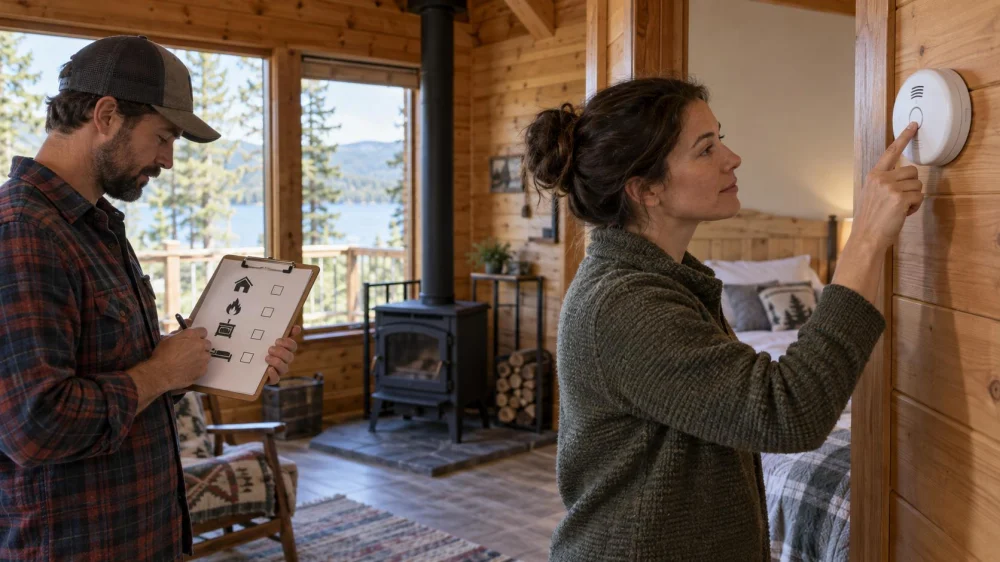
Camping Cabin Carbon Monoxide Alarm: Check and Respond
On this page
Quick answer
Before staying in a camping cabin, verify that working smoke and carbon monoxide alarms are installed and ask about fuel-burning equipment. On arrival, locate the alarms and follow the provided test instructions without disabling them. If a CO alarm sounds or people develop headache, dizziness, weakness, nausea, chest pain, or confusion, move everyone into fresh air and call emergency services.

Ask before booking
The U.S. Consumer Product Safety Commission advises vacation-rental guests to verify that a property has smoke and carbon monoxide alarms and a fire extinguisher before signing. Ask the host which fuel-burning appliances are present, when they were inspected, and how emergency maintenance works.
- Are CO alarms installed on each required level and near sleeping areas?
- Are alarms hard-wired, battery-powered, or both?
- Does the cabin have a fireplace, wood stove, furnace, water heater, generator, or attached garage?
- Who should guests call after hours?
- Where is the meeting point outside?
Local rules may set specific alarm placement and maintenance requirements. The owner or operator remains responsible for required equipment; a guest’s checklist does not replace that duty.

Rocky Ridge Estates
East StroudsburgMonroe CountyPennsylvania
7712 Ralston Ct, East Stroudsburg, PA 18302, USA
Check alarms on arrival
Walk through the cabin before settling in. Locate smoke and CO alarms, exits, extinguisher, appliance instructions, and emergency contact information. Look for a missing unit, removed battery, damage, warning chirp, or blocked alarm.
Use the alarm’s test button only as instructed. A test checks some alarm functions but does not prove the air is safe or replace maintenance. Do not cover, remove, relocate, paint, or silence an alarm. Report any fault immediately and do not use fuel-burning equipment while protection is uncertain.
Prevent carbon monoxide buildup
Carbon monoxide is colourless and odourless. You cannot use smell, appearance, or how a flame looks to decide that the air is safe. CDC warns never to burn charcoal or use a portable gas camp stove indoors.
- Use fireplaces, stoves, and heaters only when the host permits and instructions are available.
- Never operate a grill, generator, or engine inside the cabin, porch enclosure, crawlspace, or garage.
- CDC advises placing a generator outdoors more than 20 feet from windows, doors, and vents.
- Do not use an oven or range to heat the cabin.
- Report blocked vents, damaged flues, soot, or repeated appliance shutdowns.
Opening a window is not a safe workaround for prohibited indoor equipment or a malfunctioning appliance.
Respond to an alarm or symptoms
Treat a CO alarm as real. Move every person and pet to fresh air without stopping to find the source. Call 911 or the local emergency number from outside and follow responder instructions. Account for everyone at the meeting place.
CDC lists common symptoms including headache, dizziness, weakness, upset stomach, vomiting, chest pain, and confusion. Sleeping people and those affected by alcohol or other substances may not notice symptoms. Do not re-enter until emergency authorities say it is safe, and seek medical evaluation as directed.
Report and document the problem
After reaching safety and contacting emergency services, notify the property operator. Record the cabin, date, time, alarm location, appliance use, symptoms, weather, and instructions received. Preserve photographs and booking messages without re-entering an unsafe building.
Ask for alternative accommodation and written follow-up. Do not reset an alarm repeatedly, install a guest-supplied device as the only fix, or resume appliance use based solely on a remote assurance.
Frequently asked questions
Can I smell carbon monoxide?
No. Carbon monoxide is colourless and odourless, so an absence of smell does not show the cabin is safe.
Is a smoke alarm also a CO alarm?
Only a listed combination unit detects both. Check the device information and ask the host; do not guess from its shape.
Should I bring a portable CO alarm?
A listed travel alarm can be an extra layer when used as directed, but it does not replace required installed alarms or make unsafe equipment acceptable.
Can I stay if the alarm battery is missing?
Report it and require a proper remedy before using the cabin. Do not accept disabled life-safety equipment.
What if the alarm chirps once in a while?
Follow the manufacturer and host instructions and report it. A fault or low-battery signal should not be ignored.
Conclusion and next steps
Verify alarms before booking, locate and check them on arrival, and use fuel-burning equipment only as permitted. Never bring grills, camp stoves, generators, or engines indoors. At an alarm or possible exposure, get everyone outside, call emergency services, and stay out until authorities clear the cabin.
Evidence note: Safety guidance comes from the CDC’s Carbon Monoxide Poisoning Basics and CPSC vacation-rental recommendations. This is prevention information, not emergency medical advice.

 Camp Gateway: Wiley Post A4.0 (17 reviews)
 West Street Village Mobile Home Community3.0 (3 reviews)
 Horsepen Branch Hiker Biker Campsite4.0 (36 reviews)
 Chisel Branch Hiker Biker Campsite4.0 (28 reviews)
 Safety Park1.0 (2 reviews)
 Drummer Boy Camping Resort4.0 (603 reviews)
 Why Winter is the Best Time for a Camping Cabin Getaway
 Best Remote Camping Cabins for Stargazing and Night Adventures in the U.S.
 The 10 Must-Have Amenities for a Comfortable Stay in Your Camping Cabin
 Winter Camping Cabins: How to Stay Cozy and Warm in the Cold
 How to Create the Ultimate Outdoor Experience with a Camping Cabin
 Best Camping Cabins with Stunning Views of National Parks and Forests