
Camping Cabin Firewood: Buy Local, Store, and Follow Rules
On this page
Quick answer
Check the cabin, campground, park, county, and fire-agency rules before buying wood. Bring no firewood from home unless the destination explicitly permits it; instead, buy approved local or certified heat-treated wood near where you will burn it. Store only in the designated dry area, use approved fireplaces or fire rings, obey every ban, and never transport leftovers to another place.
Creekside Estates
BristolNaugatuck Valley Planning RegionConnecticut
482 Broad St, Bristol, CT 06010, USA
Check rules before the trip
A cabin booking does not guarantee that indoor or outdoor fires are allowed. Read the current property rules and official fire restrictions for the date of your stay. Conditions can change after booking because of wind, drought, air quality, pest quarantines, or equipment maintenance.
- Which fireplace, stove, grill, or fire ring may be used?
- Is wood supplied, sold onsite, or limited to approved vendors?
- Are outside firewood, gathering, or cutting prohibited?
- Is a permit required?
- What extinguishing tools and supervision are required?
- Where should ashes and unused wood remain?
If a burn ban or property rule prohibits a fire, use an allowed alternative. Do not assume a small fire or indoor stove is exempt.

Chesapeake Ranch Estates Campgrounds
295 Thunderbird Dr, Lusby, MD 20657, USA
Buy it where you burn it
Firewood can carry insects and diseases hidden in bark or wood. Moving it can introduce forest pests to a new area even when the wood looks clean. USDA APHIS recommends buying firewood where you burn it and using heat-treated firewood if movement is unavoidable.
Use the campground’s recommended seller or another vendor that meets the destination’s distance and certification rules. Keep the receipt or treatment label until staff confirm the wood is acceptable. “Kiln dried” is not automatically the same as certified heat treated under every rule.
Store firewood safely
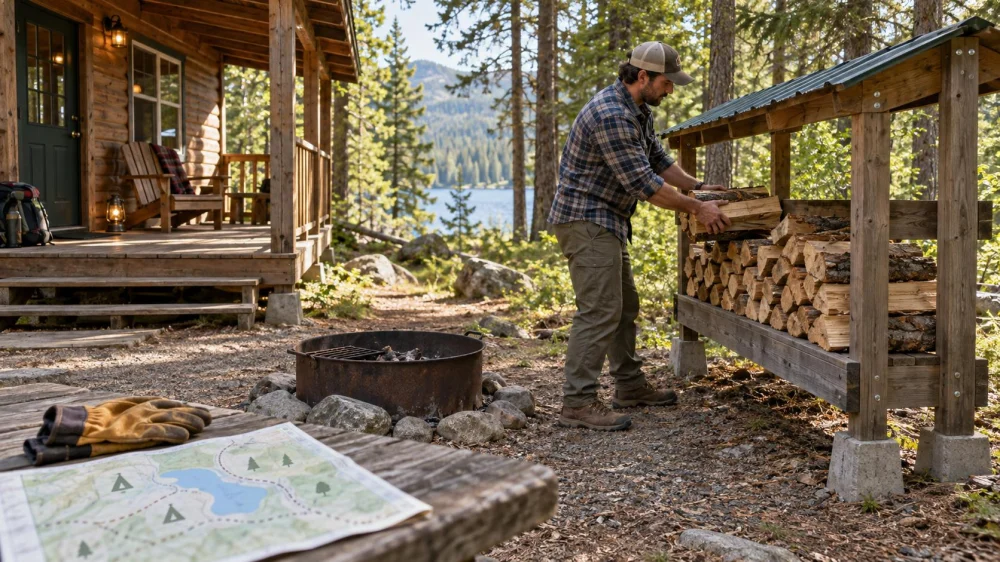
Use the rack, box, or location designated by the property. Keep wood dry and stable without blocking doors, steps, paths, vents, utility panels, extinguishers, or emergency exits. Do not stack against the cabin unless the property specifically designed and permits that storage.
- Keep bundles where children and pets will not pull them down.
- Do not bring unknown wood, insects, or loose bark into sleeping areas.
- Separate ignition sources from stored wood.
- Keep only a manageable amount near the approved appliance.
- Report a damaged rack, chimney concern, or pest signs to staff.
Use only approved fire areas
Follow the appliance instructions and cabin rules. Never improvise a fire on a porch, on bare ground, in a decorative fireplace, or in damaged equipment. Burn only the material allowed by the property—never rubbish, packaging, treated lumber, painted wood, or accelerants.
Keep the fire attended by a responsible adult, control sparks, and have the required water or extinguisher available. If smoke enters the cabin, an alarm sounds, ventilation fails, or conditions become unsafe, leave the area and follow emergency and property instructions.
Handle leftovers correctly
Follow checkout instructions for ashes and unused wood. Do not place hot ashes in a bin, on soil, or near vegetation. A fire can remain hot below the surface after visible flames disappear; use the site’s extinguishing method and confirm it is cold when rules require you to do so.
Do not carry leftover wood to your home, another campsite, or another region. The National Park Service advises leaving unused wood at the campsite or with a host where permitted. Ask staff rather than dumping it or taking it elsewhere.
Frequently asked questions
Can I collect dead branches near the cabin?
Only if the land manager expressly allows it. Many areas prohibit gathering to protect habitat and control pests or fire risk.
Is packaged firewood always acceptable?
No. The destination may require local origin, an approved vendor, or a specific heat-treatment certification.
Can I save leftover wood for the next trip?
Do not move it. Ask the host where approved leftovers should remain.
What if a fire ban starts during my stay?
Stop the prohibited activity and follow current official and property directions, even if the booking materials were older.
May I burn cardboard or wrappers?
Use only fuels allowed by the appliance and property. Dispose of packaging through the designated waste system.
Conclusion and next steps
Check current fire and firewood rules, buy approved wood near the cabin, and store it only where directed. Use approved equipment under supervision, extinguish exactly as required, and leave unused wood in the permitted local system. When any rule or condition is unclear, skip the fire until staff confirm.
Evidence note: This guide uses USDA APHIS advice to buy firewood where you burn it. Fire restrictions and property rules are local and time-sensitive.
 Camp Gateway: Wiley Post A4.0 (17 reviews)
 West Street Village Mobile Home Community3.0 (3 reviews)
 Horsepen Branch Hiker Biker Campsite4.0 (36 reviews)
 Chisel Branch Hiker Biker Campsite4.0 (28 reviews)
 Safety Park1.0 (2 reviews)
 Drummer Boy Camping Resort4.0 (603 reviews)
 Why Winter is the Best Time for a Camping Cabin Getaway
 Best Remote Camping Cabins for Stargazing and Night Adventures in the U.S.
 The 10 Must-Have Amenities for a Comfortable Stay in Your Camping Cabin
 Winter Camping Cabins: How to Stay Cozy and Warm in the Cold
 How to Create the Ultimate Outdoor Experience with a Camping Cabin
 Best Camping Cabins with Stunning Views of National Parks and Forests