
Camping Cabin Power Outage: Lights, Food, and Updates
On this page
- Quick answer
- Make the first minutes calm and safe
- Use safe light sources
- Keep combustion equipment outside
- Protect food and verify the water supply
- Preserve communications and medical support
- Get reliable updates and document the outage
- Decide whether the cabin remains usable
- Limits and important notes
- Frequently asked questions
- Sources and evidence notes
- Conclusion and next steps
Quick answer
During a camping cabin power outage, use battery lights instead of candles, keep refrigerator and freezer doors closed, unplug sensitive devices if the host advises, and never run a generator, grill, stove, or vehicle in or near an enclosed space. Confirm water, heating, medical-device, alarm, and access impacts with the host. Follow food-safety guidance, preserve phone power, and leave if the cabin cannot remain safely occupied.
Make the first minutes calm and safe
- Stop moving until everyone has a light and can see steps, loft ladders, furniture, and exits.
- Account for every person and pet.
- Check for smoke, fire, gas odour, sparking, flooding, or damaged lines without touching equipment.
- Call emergency services and leave if there is an immediate hazard.
- If there is no immediate danger, contact the cabin host or campground operator and ask whether the outage is local or widespread.
Do not repeatedly reset breakers, open utility panels, or repair wiring unless the property owner has specifically authorized a qualified person to do so.
Use safe light sources
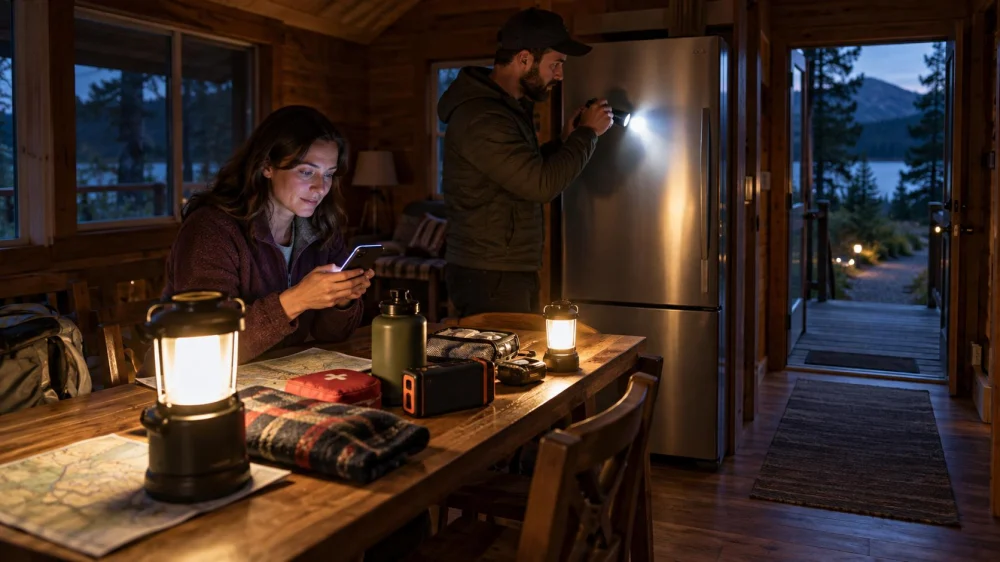
Use charged headlamps, flashlights, and battery lanterns so hands remain free on stairs and outside paths. Place a light near the main exit and another near sleeping areas, but keep beams from dazzling people on steps.
Avoid candles and improvised flames. They add fire and carbon monoxide risk, can be knocked over in unfamiliar rooms, and may violate property rules. Preserve at least one light with fresh batteries for an overnight evacuation.
Keep combustion equipment outside
Never operate a portable generator, charcoal grill, camp stove, fuel heater, or running vehicle inside a cabin, porch enclosure, garage, tent, or other partly enclosed area. Exhaust can enter through doors, windows, vents, and gaps.
Only use equipment the host permits and follow its manual, placement rules, weather protection, and electrical limits. If a carbon monoxide alarm sounds, or anyone develops headache, dizziness, weakness, nausea, chest pain, or confusion, move everyone to fresh air and call emergency services.
Protect food and verify the water supply
Keep refrigerator and freezer doors closed and note when power failed. Do not taste food to decide whether it is safe. Use official food-safety time and temperature guidance, and discard food when its safety cannot be established.
Ask whether the outage affects the well pump, water treatment, hot water, toilets, or a boil-water advisory. Use sealed backup water until the host or local authority confirms the supply is safe. Do not assume a clear tap means the system is operating normally.
Preserve communications and medical support
- Switch phones to low-power mode and reduce screen brightness.
- Use a power bank before relying on a vehicle; never idle a vehicle near the cabin.
- Save the host, campground, utility, local emergency, and nearest medical contact details offline.
- Tell the host immediately about powered medical devices, refrigerated medicines, mobility lifts, or other essential equipment.
- Use the person's established backup plan and contact the clinician, equipment provider, or emergency service when support is uncertain.
Get reliable updates and document the outage
Ask the host for the estimated restoration time, affected systems, permitted backup equipment, and how updates will be delivered. Utility outage maps and local emergency alerts may provide broader information, but the host should confirm property-specific conditions.
Record the outage start time, messages, visible damage, indoor temperature concerns, food decisions, and any expenses. Photographs can help with a later discussion, but do not enter restricted utility areas to take them.
Decide whether the cabin remains usable
Consider leaving if safe lighting, heat or cooling, drinking water, sanitation, alarms, medical support, communication, or an accessible exit cannot be maintained. Weather, wildfire, flooding, falling trees, road conditions, and the needs of children, older adults, pets, and disabled guests can shorten the safe waiting period.
Agree on a departure threshold before conditions worsen. Know the route, fuel level, keys, meeting point, and a backup lodging option. Follow evacuation orders immediately.
Limits and important notes
This guide supports general planning and does not replace emergency instructions, utility advice, equipment manuals, local food and water advisories, or medical guidance. Cabin systems and rental responsibilities vary.
Do not connect a generator directly to cabin wiring or use an unapproved cord. Backfeeding and overloaded circuits can injure occupants and utility workers. Report damaged lines from a safe distance.
Frequently asked questions
Should we open the refrigerator to move food?
Usually, keep it closed while you confirm outage timing and official food-safety guidance. Opening it releases cold air. Move food only with a safe, planned cold-storage option.
Can we use a fireplace?
Only if the host permits it, the appliance is designed and inspected for use, alarms are working, ventilation is correct, and you can follow every property rule. A fireplace is not a universal outage solution.
Who should arrange alternative lodging?
Contact the host or booking service promptly and review the reservation terms. Safety comes first; document conditions and communications for any later reimbursement discussion.
Sources and evidence notes
This article follows general US emergency-lighting, carbon monoxide, generator, food-safety, water-supply, and travel-planning principles. For a real outage, rely on emergency services, the property host, the electric utility, local public-health notices, equipment instructions, and the needs of your group.
Conclusion and next steps
Before a cabin stay, pack battery lights, power banks, water, shelf-stable food, essential medicines, and offline contact details. On arrival, locate exits, alarms, the host's outage instructions, and a safe meeting point. During an outage, communicate early and leave before essential systems or safe access fail.


 Round Top Campground4.0 (484 reviews)
 Sunrise Trailer Court Inc4.0 (45 reviews)
 Country Acres Manufactured Home Village4.0 (41 reviews)
 Penn View Mobile Home Park3.0 (53 reviews)
 Urban Acres4.0 (18 reviews)
 Valley View Tuckerton Mobile Home Park3.0 (40 reviews)
 Why Winter is the Best Time for a Camping Cabin Getaway
 Best Remote Camping Cabins for Stargazing and Night Adventures in the U.S.
 The 10 Must-Have Amenities for a Comfortable Stay in Your Camping Cabin
 Winter Camping Cabins: How to Stay Cozy and Warm in the Cold
 Best Camping Cabins with Stunning Views of National Parks and Forests
 How to Create the Ultimate Outdoor Experience with a Camping Cabin