
How to Check a Camping Cabin's Lighting and Power Setup
On this page
Quick answer
Confirm whether the cabin has electricity, which outlets and lights are available, and whether power is continuous, seasonal, solar, generator-based, or restricted. On arrival, look for damage, heat, moisture, loose covers, and overloaded adapters without touching questionable equipment. Bring battery lighting and charged power banks, prioritise medical and communication needs, and report electrical faults to the operator instead of repairing them.
This guide is for camping-cabin stays in the United States. Electrical systems and campground rules vary. Follow the cabin operator, equipment instructions, and local emergency guidance.
Ask before booking
“Electric cabin” can mean one light and one outlet or a full residential-style system. Ask what is powered, when it operates, and what guests may plug in.
- Are outlets indoors, outdoors, or both?
- Is power available overnight?
- Are high-wattage appliances prohibited?
- Does the cabin use utility, solar, or generator power?
- Are USB ports provided, and are they maintained?
- How are outages reported?
- Can essential medical equipment be supported reliably?
If power is medically essential, do not rely on a general amenity listing. Discuss requirements with the operator and healthcare or equipment provider and maintain an appropriate backup plan.

Indian Rock RV Park & Campground
Jackson TownshipOcean CountyNew Jersey
920 W Veterans Hwy, Jackson Township, NJ 08527, USA
Inspect safely on arrival
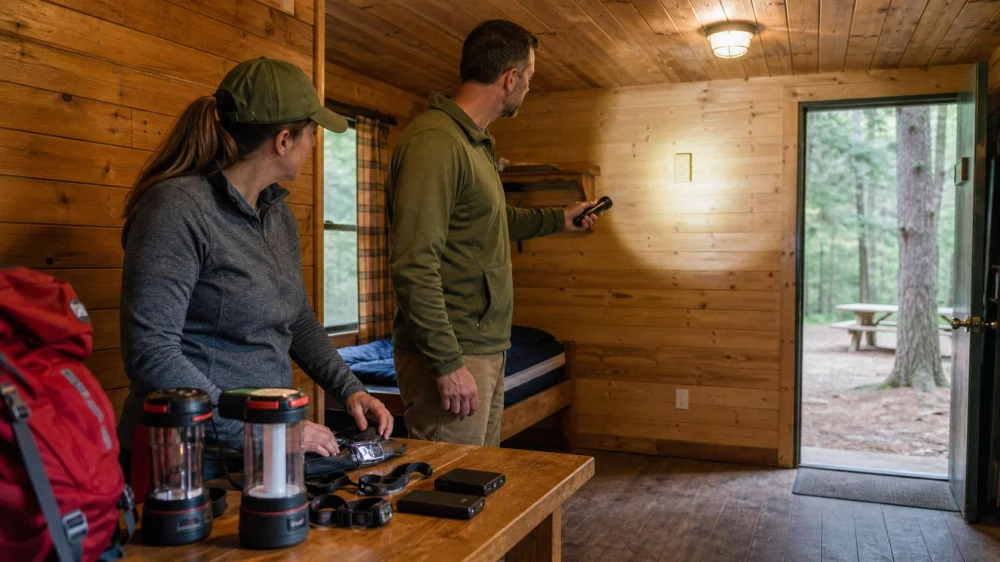
In daylight, locate switches, lights, outlets, the operator contact, and the safe route to the toilet or exit. Look for cracked covers, exposed wires, scorch marks, buzzing, unusual heat, sparks, water near electricity, or damaged extension cords.
Do not open panels, reset repeated breaker trips, move generator equipment, or test a suspicious outlet. Stop using the area and contact staff. For smoke, fire, shock, or immediate danger, leave and call emergency services.
Match power to essential needs
List needs in order: medical equipment, phone communication, navigation, lighting, refrigeration required for approved items, and optional entertainment. Confirm voltage, plug type, charging time, and device compatibility.
A limited solar system may not support heaters, kettles, hair dryers, cooking appliances, or multiple chargers. Never use fuel-burning equipment indoors to replace electric heat or cooking.
Charge power banks before travel and keep a battery reserve for the return trip. Download maps and booking information offline.
Use cords and devices safely
Use listed, undamaged equipment suitable for the environment and load. Keep cords out of doorways, walkways, bedding, and wet areas. Do not daisy-chain power strips or place cables under rugs or mattresses.
Outdoor outlets and cords require outdoor-rated equipment and weather protection. Do not run cords through windows or doors where they can be crushed. Keep charging devices on hard ventilated surfaces, not inside bedding.
Follow operator rules for electric cooking, heating, e-bikes, mobility devices, and vehicle charging. A standard cabin outlet may not be approved for those loads.
Prepare for an outage
Bring individual headlamps or torches with spare batteries. Keep one light beside each sleeping area and another near the exit. Avoid candles and open flames unless explicitly permitted and safely managed; battery lights are usually the lower-risk option.
Know the route to staff, vehicle, toilet, and assembly point. During an outage, conserve phone power and report the problem through the designated channel. Do not approach generators or utility equipment.
Cabin power checklist
- Confirm source, schedule, outlets, limits, and outage process.
- Plan separately for essential medical power.
- Inspect visible equipment in daylight.
- Report heat, damage, buzzing, sparks, or moisture.
- Use compatible undamaged devices and cords.
- Keep cables dry, ventilated, and outside walkways.
- Pack headlamps, batteries, and charged power banks.
- Never improvise with indoor fuel-burning equipment.
Limitations and important notes
- Power availability can change with weather, fire restrictions, maintenance, and system capacity.
- A surge protector does not make damaged wiring safe.
- Portable generators produce deadly exhaust and require trained placement and operation by the responsible operator.
- Children need supervision around outlets, cords, batteries, and charging devices.
- Damaged lithium batteries should not be charged or stored in the cabin.
Frequently asked questions
Can I bring a space heater?
Only if the operator explicitly allows it and the electrical system and device instructions support it. Never use it near bedding or unattended.
Are cabin USB ports safe?
Inspect for damage and use privacy-conscious charging equipment. Bring your own approved charger when uncertain.
What if a breaker trips?
Unplug personal devices and contact the operator. Do not repeatedly reset it or open a panel.
Can I charge an e-bike battery?
Ask the operator and follow the battery manufacturer. Many cabins restrict charging because of load and fire risk.
Should I bring candles?
Battery lighting avoids open-flame risk. Follow cabin and fire rules, which may prohibit candles entirely.
Sources and evidence notes
The approach reflects common electrical and camping safety: verify system capacity, inspect without repair, keep cords dry and ventilated, prioritise essential loads, and maintain battery lighting. The operator and equipment manufacturers provide site-specific rules.
Pack light before power
Ask the cabin operator exactly what runs overnight and which devices are prohibited. Pack one headlamp per person, spare batteries, and charged power banks before adding optional electronics. At check-in, inspect the visible setup and report anything damaged before plugging in.

 Batona Campground4.0 (55 reviews)
 Three Gardens4.0 (7 reviews)
 Eastern Dawn Inc4.0 (32 reviews)
 Holly Lake Campsites - Holly Lake Camp Store & Grill4.0 (601 reviews)
 Par 4 artist's retreat0.0 (0 reviews)
 Whippoorwill Campground4.0 (276 reviews)
 Why Winter is the Best Time for a Camping Cabin Getaway
 Best Remote Camping Cabins for Stargazing and Night Adventures in the U.S.
 The 10 Must-Have Amenities for a Comfortable Stay in Your Camping Cabin
 Winter Camping Cabins: How to Stay Cozy and Warm in the Cold
 Best Camping Cabins with Stunning Views of National Parks and Forests
 How to Create the Ultimate Outdoor Experience with a Camping Cabin