
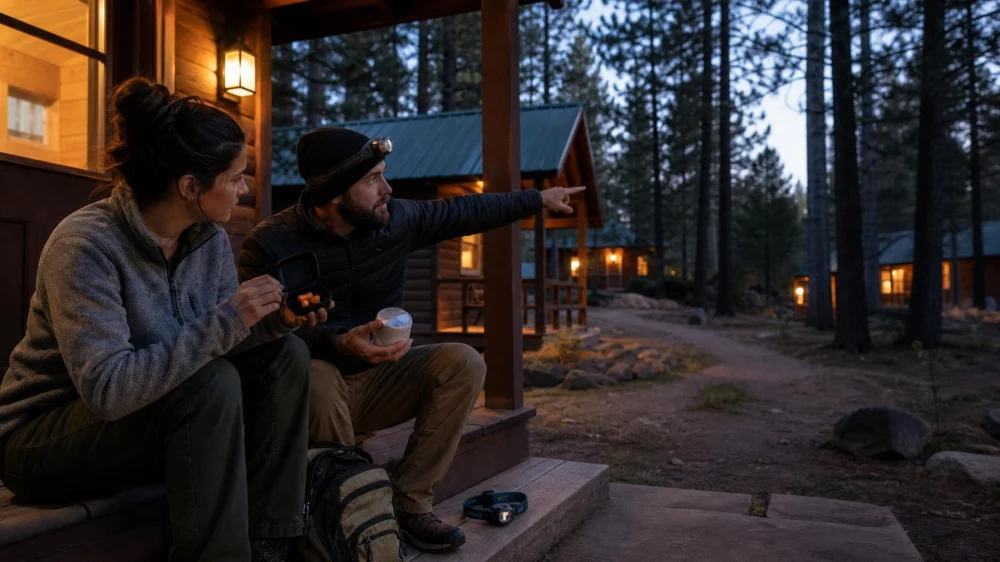
How to Plan for Noise and Quiet Hours at a Camping Cabin
On this page
- Quick answer
- Check the setting before booking
- Confirm quiet-hour rules
- Choose the cabin location carefully
- Build a realistic sleep plan
- Handle noise safely and politely
- Quiet-cabin checklist
- Limitations and important notes
- Frequently asked questions
- Sources and evidence notes
- Ask about the nearest noise source
Quick answer
Plan for cabin noise by confirming the campground's quiet hours, enforcement contact, generator rules, nearby roads and activity areas, and any scheduled events. Choose a cabin away from toilets, playgrounds, group sites, gates, and service areas when sleep matters. Bring comfortable hearing protection or white noise that still allows emergency alerts, and report persistent problems through staff rather than confronting other guests.
This guide is for camping-cabin stays in the United States. Rules and natural sound conditions vary by property, season, weather, and wildlife.
Murray Manor Manufactured Home Community
WilmingtonNew Castle CountyDelaware
5600 Old Capitol Trl, Wilmington, DE 19808, USA
Check the setting before booking
Look at an official site map and recent operator information. Ask whether the cabin is near a highway, railway, boat launch, event venue, group loop, toilet block, rubbish collection point, playground, parking area, or staff facility.
Confirm seasonal sources such as festivals, hunting activity where lawful, early fishing departures, maintenance, construction, and generators. Natural settings also include wind, rain, insects, frogs, birds, and wildlife; a remote cabin is not silent.

Confirm quiet-hour rules
Ask when quiet hours begin and end and what they restrict: amplified music, voices, generators, vehicles, outdoor lighting, and pet noise. Find out whether arrival gates close and how late check-ins work.
Save the host, ranger, or after-hours contact. Understand whether rules are enforced by campground staff, land managers, or another authority. Do not assume emergency services handle ordinary campground disputes.
Choose the cabin location carefully
A cabin at the edge of a loop may reduce passing foot traffic but be closer to a road or wildlife corridor. One near facilities shortens walks but increases doors, voices, and vehicle movement.
- Ask for distance from group and activity areas.
- Check whether walls are detached or shared.
- Confirm parking and generator locations.
- Ask which cabins suit early sleepers or families.
- Verify accessible routes before trading proximity for quiet.
Do not request an isolated location that creates unacceptable mobility, lighting, communication, or emergency-access barriers.
Build a realistic sleep plan
Bring familiar sleep items, window coverings only when permitted, and hearing protection that fits safely. A fan or white-noise device requires approved power and should not block alarms, weather alerts, children, or necessary communication.
For children, preserve the usual wind-down routine and explain expected outdoor sounds. For pets, follow property rules, prevent persistent barking, and never leave an animal unattended when prohibited or unsafe.
Keep doors and windows secure. Do not sleep in a vehicle or outdoor area solely to escape noise without confirming legality and safety.
Handle noise safely and politely
First confirm the time and source. A brief required vehicle movement, emergency response, storm, or wildlife sound differs from prolonged music.
Use the campground contact and provide cabin number, time, duration, and observable source. Avoid escalating a confrontation, especially when alcohol, weapons, or aggressive behaviour may be present.
For threats, violence, fire, medical emergencies, or immediate danger, move to safety and contact emergency services.
Quiet-cabin checklist
- Read quiet hours and generator rules.
- Check roads, group sites, facilities, events, and shared walls.
- Balance quiet with accessibility and emergency access.
- Pack safe hearing and sleep supports.
- Preserve alarm and alert awareness.
- Plan for children and pet noise.
- Save the after-hours operator contact.
- Report rather than confront persistent disruption.
Limitations and important notes
- Quiet hours reduce avoidable noise but do not promise silence.
- Earplugs require correct fit and may be unsuitable when a person must hear dependants or alarms.
- Generators create exhaust and fire hazards as well as noise; never move or operate campground equipment.
- Wildlife should not be approached or harassed because of sound.
- Weather can amplify or change sound unexpectedly.
Frequently asked questions
Are generators allowed during quiet hours?
Rules vary. Confirm the property schedule and any medical-power process before arrival.
Is a cabin quieter than a tent?
Often it blocks some sound, but construction, shared walls, windows, and location matter.
Can I ask for a different cabin?
Ask about availability, fees, and access before arrival. A move may not be possible after check-in.
Should I speak directly to noisy neighbours?
Use staff channels when confrontation could escalate. A polite request may be appropriate only when safe and consistent with property guidance.
What if wildlife keeps me awake?
Remain inside or at a safe distance, secure food, and follow land-manager guidance. Do not chase or feed wildlife.
Sources and evidence notes
The plan reflects common campground etiquette and risk management: verify rules, choose location deliberately, preserve alarm awareness, manage household noise, and use staff enforcement channels. The property or land manager provides current rules.
Ask about the nearest noise source
Before booking, identify the cabin on the official map and ask what is closest after dark: road, facility, group site, event area, generator, or shared wall. Confirm quiet hours and the after-hours contact, then pack sleep supports that do not prevent you from hearing essential alerts.
 Batona Campground4.0 (55 reviews)
 Three Gardens4.0 (7 reviews)
 Eastern Dawn Inc4.0 (32 reviews)
 Holly Lake Campsites - Holly Lake Camp Store & Grill4.0 (601 reviews)
 Par 4 artist's retreat0.0 (0 reviews)
 Whippoorwill Campground4.0 (276 reviews)
 Why Winter is the Best Time for a Camping Cabin Getaway
 Best Remote Camping Cabins for Stargazing and Night Adventures in the U.S.
 The 10 Must-Have Amenities for a Comfortable Stay in Your Camping Cabin
 Winter Camping Cabins: How to Stay Cozy and Warm in the Cold
 Best Camping Cabins with Stunning Views of National Parks and Forests
 How to Create the Ultimate Outdoor Experience with a Camping Cabin